


If you’re reading this at 3 a.m. with a baby who seems to think the middle of the night is party time, take a breath: you’re doing better than you think. A newborn sleep schedule in the first three months isn’t really a “schedule” at all in the way you might imagine. It’s more like a slowly emerging rhythm, and your job for now is mostly to follow your baby’s cues, protect their sleep, and survive the foggy days with as much grace as you can muster.
In this week-by-week guide, I’ll walk you through how much sleep newborns actually need, how long they can comfortably stay awake (those famous “wake windows”), why day and night get hilariously mixed up at first, and roughly when those longer night stretches start to appear. Every baby is different, so treat these numbers as gentle guideposts, not rules. And above all, every nap and every night follows the same safe sleep basics, which I’ll cover first because they matter more than any timing.
Safe sleep comes first, always
Before we talk timing, let’s lock in the non-negotiables. No matter the week or the schedule, every single sleep should follow these rules:
- Back to sleep. Always place your baby on their back for every nap and every night.
- Firm, flat surface. Use a crib or bassinet with a firm, flat mattress and a tight-fitting sheet, nothing more.
- Empty bed. No loose blankets, pillows, bumpers, positioners, or stuffed animals.
- Room-share, don’t bed-share. Keep baby’s bassinet in your room, ideally for at least the first 6 months.
- Comfortable, not hot. Keep the room at a comfortable temperature and avoid overheating.
If your baby seems cold, a wearable blanket is the safe way to keep them cozy without loose bedding. A properly sized sleep sack does the job beautifully.
How much sleep do newborns really need?
Newborns sleep a lot, just not in the long, convenient blocks we’d love. Across the first three months, most babies sleep somewhere between 14 and 17 hours in every 24-hour period, broken into many short chunks. That total is spread across both day and night, which is exactly why your nights feel so broken in the early weeks.
Here’s the part nobody warns you about: those hours come in stretches of 1 to 4 hours at a time, with feeds in between. This is normal and, importantly, it’s protective. Newborns have tiny tummies and genuinely need to feed often, including overnight.

Wake windows week by week
A “wake window” is simply how long your baby can happily stay awake between sleeps before they get overtired. Catching that window helps sleep come more easily. These are typical ranges, your baby may run shorter or longer:
Weeks 1-2: the sleepy newborn
- Wake windows: 30-60 minutes (yes, that short).
- Total sleep: 16-18 hours, often more.
- What to expect: Your baby may fall asleep mid-feed. Lots of cluster feeding, lots of dozing. Don’t expect predictability.
Weeks 3-4: a little more alert
- Wake windows: 45-75 minutes.
- Total sleep: 15-17 hours.
- What to expect: Some babies hit a fussy “witching hour” in the evening around now. It’s exhausting but normal and it passes.
Weeks 5-8: glimmers of rhythm
- Wake windows: 60-90 minutes.
- Total sleep: 14-17 hours.
- What to expect: Around 6-8 weeks many babies offer one slightly longer night stretch and start to give you real smiles. Worth every yawn.
Weeks 9-12: the schedule starts whispering
- Wake windows: 75 minutes to 2 hours.
- Total sleep: 14-16 hours.
- What to expect: Naps may begin consolidating into a loose pattern, and the longest night stretch often grows to 4-6 hours for some babies.
Want the bigger picture, mama?
These first 12 weeks are just the opening chapter. For what comes next, save our gentle baby sleep guide for the first year, and if you’re keeping baby cozy the safe way, here’s our honest take on choosing a sleep sack instead of loose blankets.
Day-night confusion (and how to gently help)
For the first few weeks, your baby has no idea that night is for sleeping. They spent nine months in the dark with no sun cues, so this is completely expected. You can’t force a circadian rhythm, but you can nudge it along gently:
- During the day: Keep things bright and a little noisy. Open the curtains, talk during feeds, let daytime feel like daytime.
- At night: Keep it boring. Dim lights, quiet voice, minimal stimulation. Feed and change with as little fuss as possible, then back to the bassinet.
- Daylight exposure: A little natural morning light for both of you helps reset that internal clock over time.
Most babies sort out their days and nights somewhere between weeks 6 and 10. Until then, hang in there.
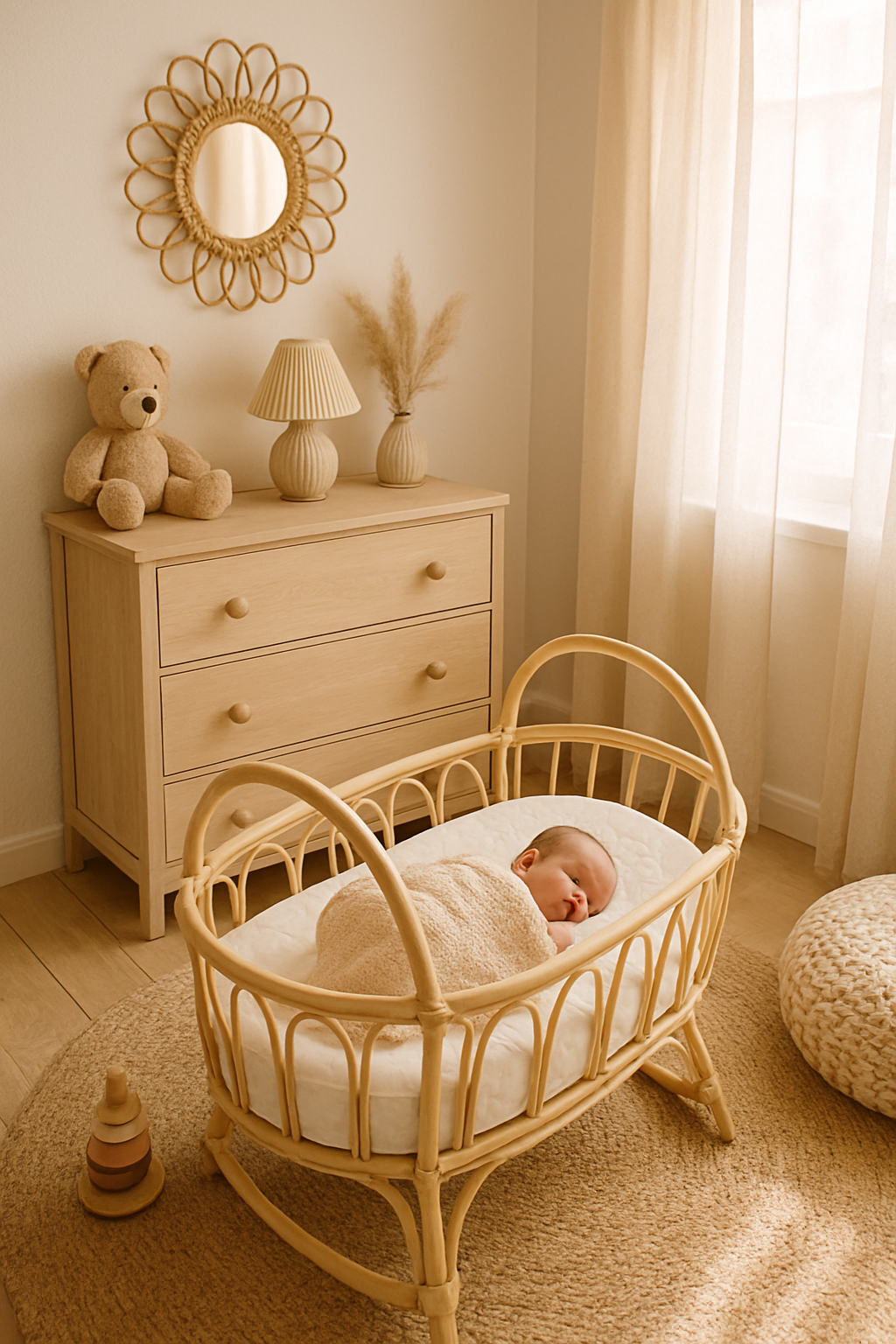
Sample daily rhythms
These aren’t schedules to enforce, they’re examples of how a flexible day might flow. Watch your baby, not the clock.
Around weeks 1-4
- Wake and feed
- Brief awake time (a diaper change, a cuddle, a little looking around)
- Back to sleep within 30-60 minutes
- Repeat roughly every 1.5 to 3 hours, around the clock
Around weeks 8-12
- Morning wake and feed (a loose “start” to the day)
- Wake window of 60-90 minutes, then a nap
- Three to five naps across the day
- A bedtime feed in a calm, dim room
- One longer night stretch, then feeds as needed until morning
A simple, repeatable bedtime wind-down (feed, fresh diaper, sleep sack, a quiet song, into the bassinet awake-ish) is a lovely habit to start now. It won’t work like magic yet, but you’re planting seeds.
When do longer stretches realistically appear?
This is the question every tired parent Googles. Here’s the honest answer: it varies enormously. Some babies give a 5-6 hour stretch by 8-12 weeks, while plenty of perfectly healthy babies are still waking every 2-3 hours at 3 months, especially breastfed babies. Neither is a problem.
Around the 4-month mark, sleep biology shifts. Your baby’s sleep matures to include more adult-like cycles, which is wonderful long-term but can temporarily cause more wake-ups (the famous “4-month progression,” often called a regression). It’s actually a sign of normal development. Keeping your consistent, safe wind-down routine through this phase pays off as things settle again.

When to check in with your pediatrician
Trust your gut, and reach out if your baby is very hard to wake for feeds, isn’t gaining weight, has fewer wet diapers than expected, or if you ever feel overwhelmed in a way that worries you. Your own rest and mental health matter enormously, please ask for help and lean on your people.
Frequently asked questions
Should I wake my newborn to feed?
In the early weeks, yes, many pediatricians recommend not letting a newborn go longer than about 3-4 hours between feeds until they’re back to birth weight and gaining well. Once your pediatrician confirms steady weight gain, you can usually let them sleep longer stretches at night. Always check with your own doctor.
Why does my baby only nap on me?
Contact naps are completely normal and developmentally typical for newborns, your warmth, smell, and heartbeat are deeply soothing. They’re not a “bad habit” at this age. For sleep that isn’t supervised contact, remember to transfer baby onto their back on a firm, flat, empty surface. Many parents do a mix, and that’s perfectly fine.
Is it too early to start a bedtime routine?
It’s never too early for a short, calm wind-down, and it won’t “spoil” anything. A simple feed-diaper-sleep sack-song sequence helps your baby start to associate certain cues with sleep over the coming weeks. Keep it brief and low-pressure for now.
My baby sleeps all day and is awake all night. Help?
This is classic day-night confusion and it’s temporary. Make days bright and engaging, keep nights dim, quiet, and boring, and get some morning daylight together. Most babies flip to a more normal pattern by 6-10 weeks. You will sleep again, I promise.
However your weeks unfold, remember that there’s no gold star for the baby who sleeps through first. You’re learning each other, one foggy day at a time, and your love is the most important thing in that bassinet. Be gentle with yourself, mama, you’ve got this.