

If you’ve ever stood over the crib at 2 a.m. wondering whether your baby is too hot, too cold, or just right, you are not alone. Figuring out how to dress a baby for sleep is one of those tiny daily decisions that feels surprisingly high-stakes, because comfortable temperature is tied directly to safe, restful sleep. The good news: once you understand a couple of simple ideas, dressing your little one becomes almost automatic, no matter the season.
This guide walks you through what to put your baby in based on your nursery temperature, what those mysterious TOG numbers actually mean, the difference between swaddles, sleep sacks, and footed pajamas, and the warning signs that your baby is over- or under-dressed. We’ll keep it warm, practical, and grounded in safe-sleep basics, which means no loose blankets in the crib. Wearable blankets are your best friend here.
How to dress a baby for sleep by room temperature
The simplest place to start is your room thermometer. A safe, comfortable nursery usually sits between 68 and 72°F (20 to 22°C). Once you know your room temp, you can match the layers. Here is a practical starting point:
- Warm room (74°F+ / 24°C+): A short-sleeve bodysuit or just a diaper under a very light (0.5 TOG) sleep sack.
- Comfortable room (69–73°F / 21–23°C): A short- or long-sleeve bodysuit under a 1.0 TOG sleep sack.
- Cool room (64–68°F / 18–20°C): A long-sleeve bodysuit or footed pajamas under a 1.5 TOG sleep sack.
- Cold room (61–63°F / 16–17°C): Footed pajamas plus a long-sleeve bodysuit underneath, paired with a 2.5 TOG sleeper.
These are guidelines, not rules carved in stone. Every baby runs a little warmer or cooler, and your job is to observe and adjust. For a printable version you can tape inside the nursery closet, see our full guide to dressing a baby for sleep.
TOG ratings explained simply
TOG stands for “Thermal Overall Grade,” which is just a fancy way of measuring how warm a fabric is. The higher the number, the more insulation it provides. You’ll see TOG ratings printed on sleep sacks and wearable blankets, and they make seasonal dressing genuinely easy once you know the scale.
- 0.5 TOG: Lightweight, breathable. Best for warm rooms and summer nights.
- 1.0 TOG: A reliable all-rounder for comfortable, temperature-controlled nurseries.
- 1.5 TOG: Mid-weight, great for spring and fall or slightly cool rooms.
- 2.5 TOG: Warm and cozy, ideal for cold winter nights.
The beauty of TOG is that you adjust warmth by changing the sack, then fine-tune with the layer underneath. Think of the sleeper as your base and the bodysuit or pajama as the dial. You can browse weight options and learn more on our sleep sacks page.

Sleep sacks vs swaddles vs footed pajamas
These three are not interchangeable, and choosing the right one depends mostly on your baby’s age and whether they’ve started rolling.
Swaddles
A swaddle wraps your newborn snugly with arms tucked in, mimicking the cozy feeling of the womb and calming the startle reflex. Swaddles are wonderful for the first weeks, but there’s a hard deadline: stop swaddling the moment your baby shows any sign of rolling over, usually around 8 to 12 weeks. A swaddled baby who rolls onto their tummy cannot push back up safely.
Sleep sacks (wearable blankets)
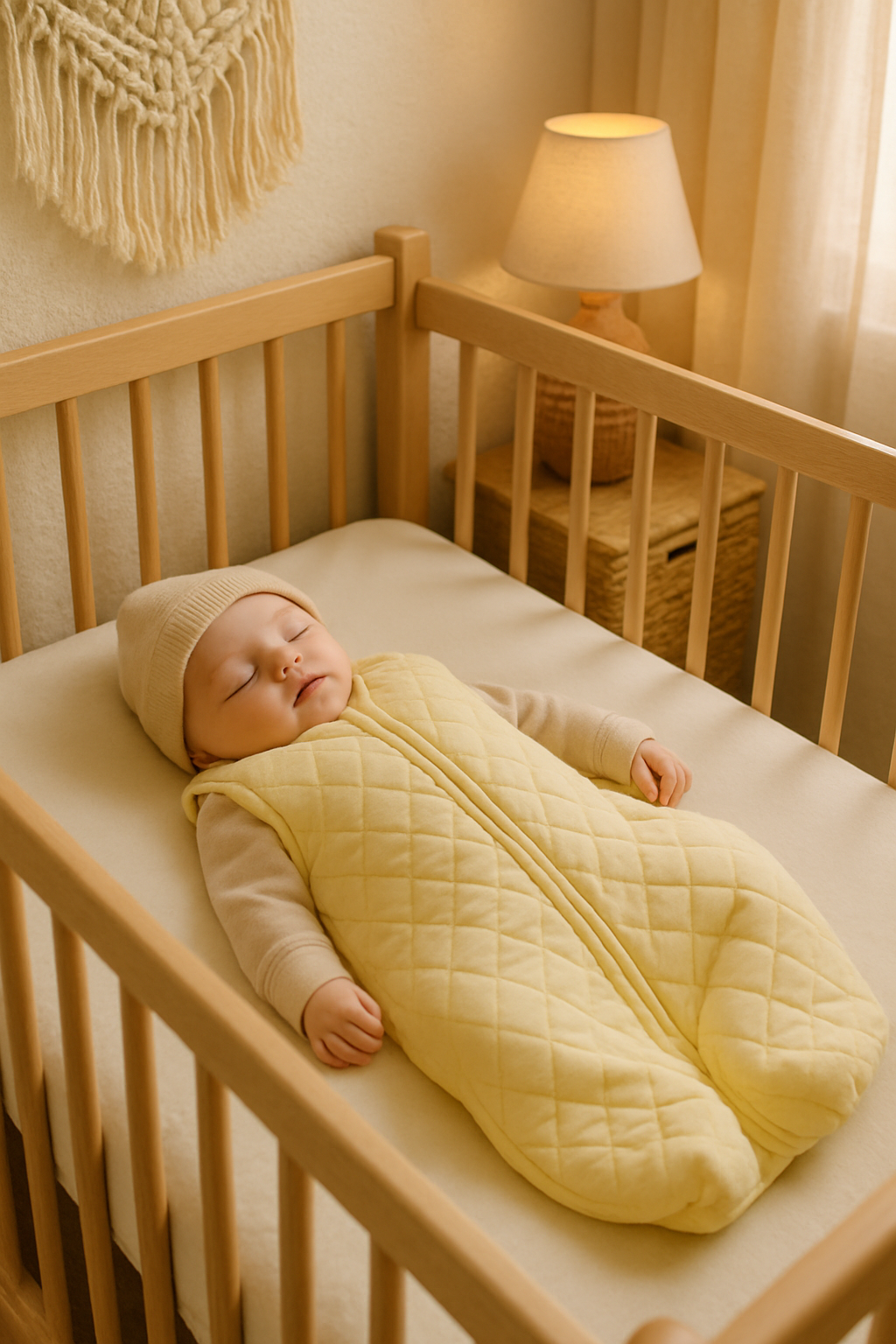
A sleep sack is a wearable blanket with armholes and a fitted body. It keeps baby warm without any loose fabric near the face, which is exactly why it’s the safe-sleep gold standard once swaddling ends. Sacks come in different TOG weights and grow with your child. They’re the layer most parents rely on month after month. Explore the styles on our wearable sleepers page.
Footed pajamas
Footed pajamas (also called footies or sleepers) cover the legs and feet in one piece, so there are no socks to kick off. They work beautifully as a standalone layer in a warm room, or as the layer underneath a sleep sack when it’s chilly.
Build your baby’s perfect sleep setup
Start with our complete how to dress a baby for sleep guide, then compare options on our wearable sleepers and sleep sacks pages. Pairing the right layers with a steady newborn sleep schedule is the fastest path to longer, calmer nights.
Signs your baby is too hot or too cold
Babies can’t tell you they’re uncomfortable, so you become the thermostat. The best place to check temperature is the chest, back of the neck, or tummy, never the hands and feet. Little hands and feet almost always feel cool because circulation there is still developing, and that’s completely normal.
Signs baby is too hot:
- Damp hair or sweat on the neck and back
- Flushed, red cheeks
- Rapid breathing or a warm, clammy chest
- Heat rash, often tiny red bumps
Signs baby is too cold:
- A cool chest or tummy (not just cool hands)
- Pale skin or a slightly mottled look
- Fussiness or trouble settling
Overheating is the bigger safety concern, so when in doubt, dress one layer lighter rather than heavier. If you feel comfortable in the room, your baby usually needs roughly the same.

Seasonal tips and the one-extra-layer rule
A handy guideline many parents swear by is the one-extra-layer rule: dress your baby in one more layer than you would comfortably wear in the same room. If you’d be cozy in a t-shirt, baby gets a bodysuit plus a light sleep sack. This rule works in every season because it’s relative to how the room actually feels, not the calendar.
- Summer: Keep it minimal. A short-sleeve bodysuit and a 0.5 TOG sack is plenty. Skip hats indoors, since babies release heat through their heads.
- Spring and fall: A 1.0 or 1.5 TOG sack over a long-sleeve bodysuit handles unpredictable temperatures well.
- Winter: Reach for a 2.5 TOG sack with footed pajamas underneath. Resist the urge to add a blanket; warm it from the inside out with layers instead.
Whatever the season, the crib itself stays bare: a firm mattress, a fitted sheet, and your baby in their wearable blanket. No loose blankets, bumpers, or stuffed animals.
Frequently asked questions
Do babies need a blanket to stay warm at night?
No. Loose blankets are a suffocation risk and are not recommended for safe infant sleep. Instead, use a wearable blanket or sleep sack in the right TOG weight for your room temperature. It keeps baby warm without anything covering the face.
How do I know if my baby is warm enough without overheating?
Feel the chest, tummy, or back of the neck. It should feel comfortably warm and dry, not hot, sweaty, or cool. Cool hands and feet are normal and not a reliable sign. When unsure, dress slightly lighter, since overheating carries more risk than being a touch cool.
Can my baby wear a sleep sack and footed pajamas together?
Yes, and this combination is perfect for cooler rooms. The footed pajamas act as the base layer and the sleep sack adds adjustable warmth on top. Just match the total warmth to your room temperature using the TOG chart above.
At what age should I switch from a swaddle to a sleep sack?
Transition as soon as your baby shows signs of rolling, typically between 8 and 12 weeks. A sleep sack lets the arms move freely while still keeping baby cozy. Pairing the switch with a consistent newborn sleep schedule can make the transition smoother.